Presentation Title
Ling Link
- We’re going to talk about the potential for sentient machines next time, but this video is an example of what sci-fi writers long ago thought it would be like
- It’s from 2001: A Space Odyssey, a movie from 1968 that was based on several short stories in the 1950s
- The computer is named HAL, and he (it?) serves as the primary antagonist in the movie; the astronaut is Dave
- For this ling link, you should pay close attention to the conversation
- Make notes about who says what (like a script)
- What is weird or interesting about the interaction?
- Are there things HAL says that sound like a real person?

But also…

Computers are stupid.
The man bit the dog.
The dog bit the man.


1. Words belong to lexical categories

We did this already, so know them!
If you are having trouble, please find a friend who is a master of parts of speech.
You will need to know these…
2. Word order is important

- It affects grammaticality and meaning.
- Mary dumped John. ≠ John dumped Mary.
- *John Mary dumped.
- *Dumped Mary John.
- Languages differ in word order ::: {.notes}
Word order is more flexible in some languages compared to English, particularly languages that heavily inflect for case.
:::
Word Order

- We usually talk about word order in terms of grammatical roles like subject (S), object (O), and verb (V)
- These pieces are combined in different ways
- SVO, SOV, VSO, VOS, OSV, OVS
- For example, Irish and Welsh are VSO
- Siaradodd Aled y Gymraeg.
- spoke Aled DEF Welsh
- Verb Subject Object
- “Aled spoke Welsh.”
- Almost no languages use OSV or OVS
- However, every language has some rules about word order.
Constituency
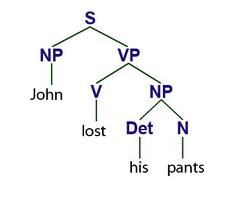
- We are trying to show that certain words clump together into groups – and even these groups clump together into bigger and bigger groups.
- So, we have to think about grammar as being hierarchical
- Like a tree rather than like a line

4. Constituents form a hierarchical structure

- Each node is equivalent to a constituent!
- Everything that hangs below a node (directly or indirectly) is inside that particular constituent, and nothing else.
- One word can belong to several different (bigger and bigger) constituents at different levels.
Why hierarchical?
- All utterances are said or written in a linear mode.
- This can lead to ambiguity…
- Yoko Ono will talk about her husband John Lennon who was killed in an interview with Barbara Walters.
- How is this ambiguous?



Activity
- Which picture could depict this sentence?
- Sarah saw a man with a telescope.
- A. This one: B. This one:
- C. Both
- Sarah saw a man with a telescope.


Help me, HAL!

- And, in addition to that, to be able respond in this way, a computer would need to:
- Recognize that “I’m afraid” can mean something like “I’m sorry” not just “I have fear”
- That using something like “I’m afraid” would be acceptable/appropriate here
- Be able to not just execute the command (=free will?!)
- Refer to the asker by name
- And so much more!
- We’ve done better with speech recognition than with true linguistic processing!
- For a computer to understand meaning, we have to give it a lot more than algorithms and probabilities!
- “Simple-minded definitions will give the wrong results.” (p. 107)

